The World’s Writing Systems
![]()
What is Writing?
With your partner, discuss the following questions:
What does writing allow humans to do that speech alone cannot?
What does speech allow humans to do that writing alone cannot?
With these differences in mind, how would you define writing?
What is Writing?
Narrowly:
- records instances of language for the future;
- allows humans to transmit information to others not within hearing distance, both spatially and temporally
What is writing?
More broadly:
- The representation of language with the use of visual or tactile signs
But what is language?
What is language?
- “Language is a complex system residing in our brains which allows us to produce and interpret utterances.” (Rogers 2005:2)
What is writing?
- The primary goal of writing is to make our utterances, which are by default audible (for spoken languages), visible
Signifier and Signified (de Saussure)
Following the very famous linguist Ferdinand de Saussure, a sign consists of two parts:
Signifier: the physical form (sound, mark, shape)
Signified: the concept or meaning associated with it
Crucially, the relationship between them is not natural, but conventional.
Signifier and Signified (de Saussure)
![]()
Icons
An icon resembles what it represents.
- A drawing of a house → ‘house’
- A stick figure → ‘person’
The connection between form and meaning is based on visual similarity.
Indices
An index points to its meaning through a direct connection.
- Smoke → ‘fire’
- Footprints → a ‘person’ passed by
The sign does not resemble its meaning, but is physically or causally linked to it.
Symbols
A symbol has an arbitrary, learned relationship to meaning.
- Words in spoken language
- Most letters and characters in writing systems
Symbols must be learned — they cannot be guessed from form alone.
Iconic signs
- Signs within a writing system may be iconic
- the signifier bears strong resemblance to the signified
- Signifier = letter, syllabogram, character, etc.
- Signified = what the sign represents (word, sound, etc.)
![]()
Egyptian < pr >, from ‘house’
Symbolic Signs
- Or symbolic
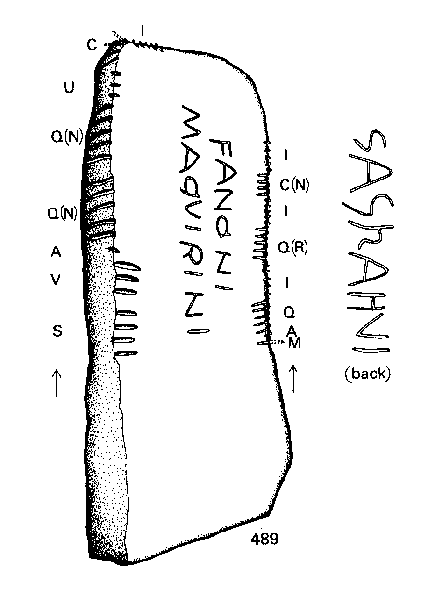
- arbitrary relationship between the signifier and signified
![]()
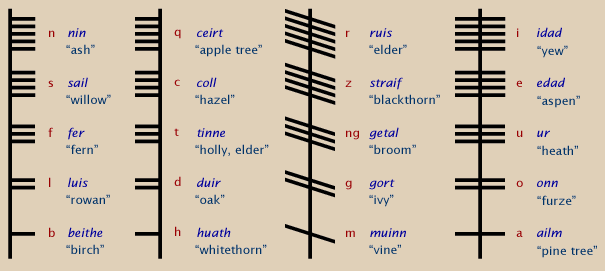
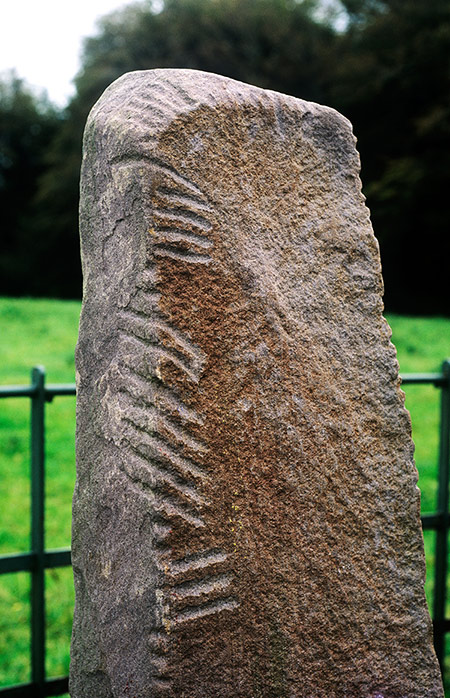
Ogham alphabet
But every writing system must represent language
![]()
pr ‘house’ & the syllable /pr/
![]() the sounds of Old Irish
the sounds of Old Irish
Iconic or Symbolic?
![]()
Iconic or Symbolic?
𓀀 — man (seated man) - logogram for “man”; also used as a determinative for male humans
𓁐 — woman - logogram for “woman”; determinative for female humans
𓀒 — death / corpse / mummy - semantic indicator for death, dying, burial
𓂻 — walking legs; determinative for motion, travel, action
𓇳 — sun / Ra - logogram for “sun” or the god Ra
Iconic or Symbolic?
𓅓 — m
𓇋 — i / y
𓈖 — n
𓆑 — f
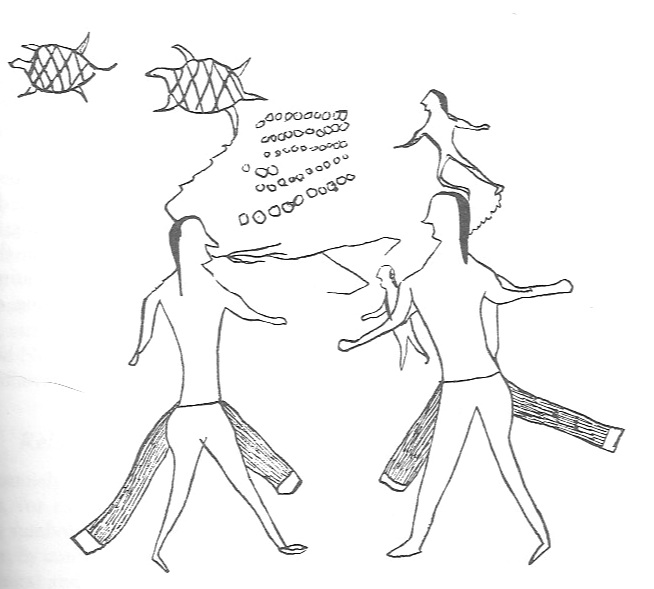
The Cheyenne Indian Letter
![]()
The Cheyenne Indian Letter
- 19th c. message from Turtle-Following-His-Wife to his son, Little Man
- Conveys the following message: “Dad (TFHW) says to return home, enclosed is $53 for the cost of the trip”
![]()
Is this writing?
![]()
writing: the representation of language with the use of visual or tactile signs
Pictographs =/= Writing
- The Cheyenne letter is an instance of pictographs, or picture writing
- Signs represent an event or an idea and not direct language
- Direct language = words, morphemes, phonemes, etc.
- Pictograph = pictorial representation of objects, ideas and events, independent of a word or utterance that refers to that object, idea or event
Chippewa Petition
![]()
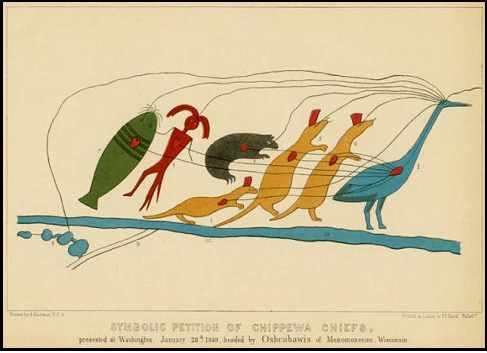
birchbark petition to Congress from seven Chippewa chiefs, 1849
Chippewa Petition
- Sent to the United States Congress by a group of Indian tribes
- Asked for fishing rights in certain small lakes
- The tribes are represented by their totems:
- Crane (leader), martens, bear, merman and catfish.
![]()
Chippewa Petition
- Lines running from the heart and eye of each animal to the heart and eye of the crane denote that they are all of one mind
- Line runs from the eye of the crane to the lakes, shown in the lower left-hand corner.
![]()
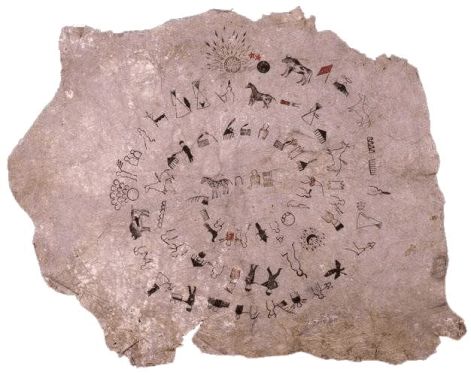
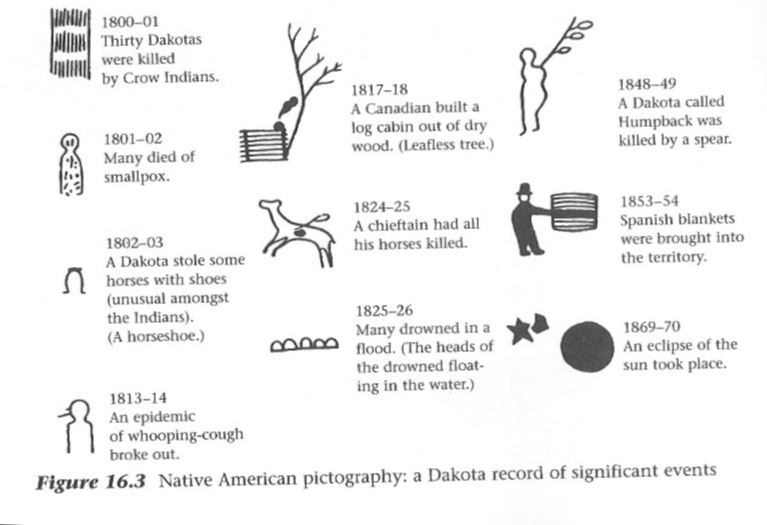
Winter counts
![]()
Lone Dog’s Winter Record: 1800-71
Winter counts
![]()
Winter Counts
![]()
Modern pictographs
- You already encounter pictographs every day — often without noticing them.
![]()
Modern pictographs
Your task is to identify three modern pictographs. Are they icons, indices, or symbols?