Decipherment

Day 25: Zapotec, Isthmian, and Olmec Scripts

Dr. Andrew M. Byrd

Review of Mayan

Previously…

We learned about the Mayan script, which is our benchmark for Mesoamerican decipherment.

Three things made it crackable:

  1. A massive corpus — thousands of texts across dozens of sites

Dresden Codex

Three things made it crackable:

  1. A calendrical anchor — Long Count dates with known values

Mayan Calendar

Three things made it crackable:

  1. Knorozov’s insight — the script is logo-syllabic, not purely logographic

Yuri Knorozov

The Syllabary

  • As we learned a few weeks back, Maya glyphs encode syllables (CV), not individual sounds.

  • Signs can be combined, substituted, and stacked — but the underlying phonetic logic is consistent once you know the system.

Maya Warm-Up

Maya Warm-Up

Using the CV syllabary:

  1. Try to write the word balam (jaguar: ba-la-ma)
  2. Then spell your neighbor’s first name in Maya glyphs (approximate the sounds)
  3. If you have time: spell one additional name! (your best friend, your pet, whatever!)

Culture Overviews

Today

  • We’ll be looking at three other Mesoamerican scripts — Zapotec, Isthmian, and Olmec.
  • Culture overviews first; scavenger hunt second!

All Three in Modern-Day Mexico

Zapotec Culture

Epi-Olmec (Isthmian) Culture
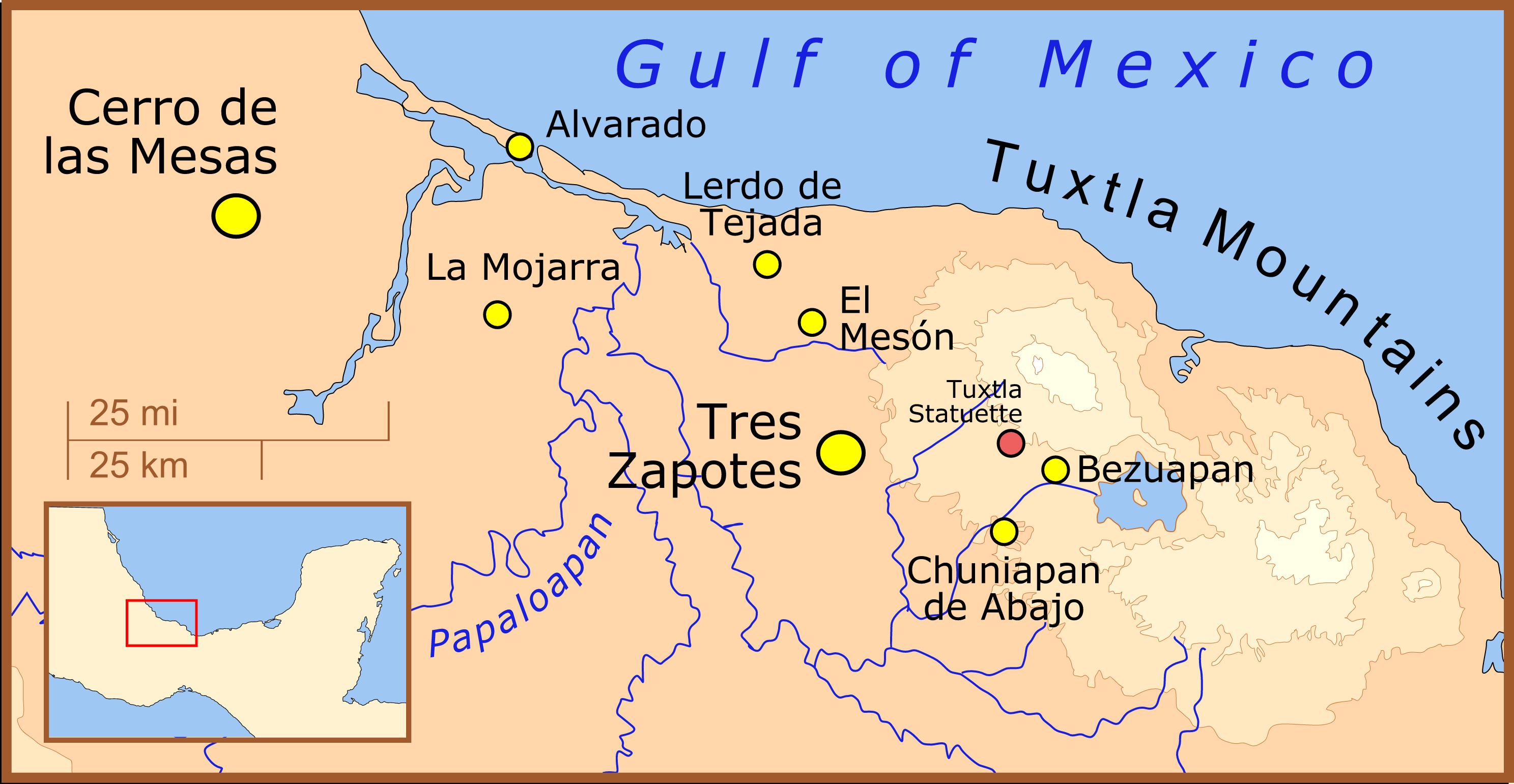
Olmec Culture

For Comparison: Maya

Zapotec

Monte Albán, Oaxaca. Wikimedia Commons · CC BY-SA

Zapotec

  • Oaxaca highlands · ~500 BCE – 700 CE
  • One of the earliest writing systems in the Americas — possibly predating all others in Mesoamerica
  • Writing appears at the city’s founding — an instrument of state power, not trade or religion

Zapotec

  • Centered on Monte Albán, a city of ~25,000 at its peak, founded ~500 BCE

Isthmian / Epi-Olmec

Huehueteotl, God of Fire Wikimedia Commons · CC BY-SA

Isthmian / Epi-Olmec

  • Gulf Coast lowlands (Veracruz/Tabasco) · ~300 BCE – 250 CE
  • Successor culture to the Olmec — hence epi- (“after”) Olmec
  • Among the first users of the Long Count calendar, an absolute dating system shared later by the Maya

Olmec

Cascajal Block, Veracruz. Wikimedia Commons · CC BY-SA

Olmec

  • Gulf Coast lowlands (Veracruz/Tabasco) · ~1500 – 400 BCE
  • The earliest major Mesoamerican civilization — known for colossal stone heads, jade work, long-distance trade
  • Sometimes called the “mother culture” of Mesoamerica — debated, but their influence was enormous

Handout Activity

How This Works

  • You have a handout (access on Canvas).
  • Three sections — one per script — each with the same three stages.
  • Work across all three cultures within each stage.
  • We’ll discuss our findings briefly between stages.

Stage 1: Scavenger Hunt

Using the links on your handout, find answers to these questions for each of the three scripts:

  1. What does the script look like? Sketch or describe 2–3 signs.
  2. How big is the corpus? (Rough number of known texts or inscriptions)
  3. What language does it possibly encode — and how confident are scholars?
  4. What is the single biggest obstacle to decipherment?

Stage 2: Text Analysis

Your handout has a specific text sample for each script. Look carefully at each one and answer:

  1. What can you observe about the signs — are they pictographic, abstract, or both?
  2. Is there any internal structure you can detect? (repetition, directionality, grouping)
  3. What would you need to begin reading this text? What’s missing?
  4. Compare to Maya: which features of this script resemble the Maya system — and which don’t?

Stage 3: Synthesis

Using everything from Stages 1 and 2, complete the ranking table on your handout:

Script Corpus Anchor Language ID Falsifiable?
Zapotec
Isthmian
Olmec

Then answer:

If you had to dedicate your career to deciphering one of these three scripts, which would you choose — and why?

Stage 3:

Script Corpus Anchor Language ID Falsifiable?
Zapotec Large ✅ Strong Probable Partial
Isthmian Tiny ✅ Long Count Contested Failed once
Olmec One text ❌ None Unknown ❌ No

Overview

What All Three Share

  • No bilingual text. No confirmed phonetic values. No living tradition of reading them.

  • And yet — they are not equally mysterious.

The difference is corpus, anchor, and falsifiability.

Key Scholars

  • Javier UrcidZapotec Hieroglyphic Writing (2001)
  • Joyce Marcus — Monte Albán epigraphy; political functions of writing
  • John Justeson & Terrence Kaufman — Isthmian decipherment (1993, 1997)
  • Stephen Houston & Michael Coe — Critique of Justeson–Kaufman (2004)
  • Rodríguez Martínez et al. — Cascajal Block, Science (2006)
  • David Freidel & Kent Reilly — Ritual bundle reading of Cascajal (2010)
  • Marc Zender — Isthmian sign catalog