Computation for Linguists
LaTeX, Day 4
Dr. Andrew M. Byrd
2025-09-05
Review
- What did you learn on Wednesday?
Glossing (LGRs)
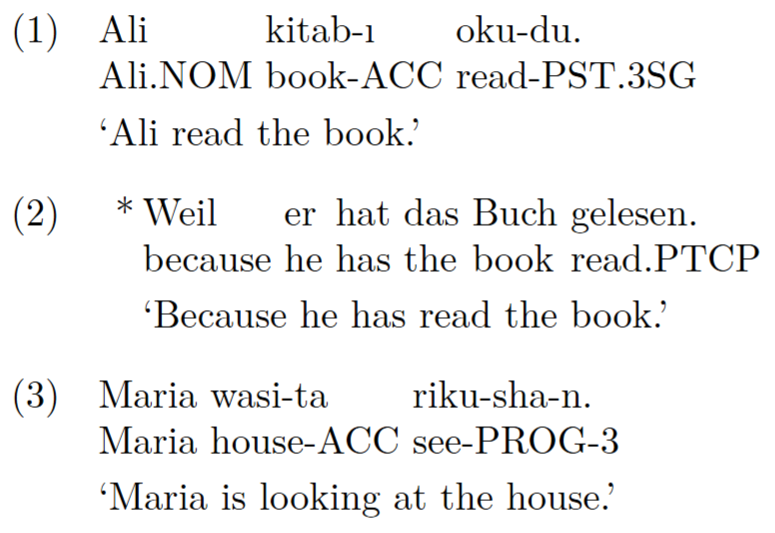
What is gb4e?
- A LaTeX package for linguistic examples, sub-examples, glosses, and Leipzig abbreviations
- You’ll write in LaTeX and compile in Overleaf
- Helpers:
gb4e(core) cgloss4e(glossing)tipa(IPA if needed)
- Helpers:
Nested sub-examples
Interlinear glossing
Ungrammatical examples
gb4e Activity
Trees
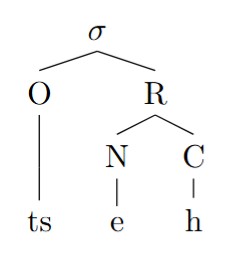
Often in Linguistics we need to draw tree structures.
Sometimes in Phonology:
Trees
Trees
Drawing Trees with the forest package
- A TikZ-based LaTeX package for drawing trees (phrase structure, stammbaum, AVMs, more).
\documentclass[12pt]{article}
\usepackage[T1]{fontenc}
\usepackage[utf8]{inputenc}
\usepackage{forest}     % trees

% A clean, reusable style for our trees:
\forestset{
  mytree/.style={
    for tree={
      align=center,
      parent anchor=south,
      child anchor=north,
      edge={-Latex},     % arrowed edges; swap to draw,-> etc.
      s sep=8mm,         % sibling sep
      l sep=8mm,         % level sep
      inner sep=2pt,
      rounded corners
    }
  }
}

\begin{document}
text
\end{document}
Let’s paste this into our document.
- How does tree structure work in
forest?
Syntax Tree Activity
- Using
forest, draw a tree of the sentence, “That cow can jump over the moon.” - Remember: PP –> P NP
Movement
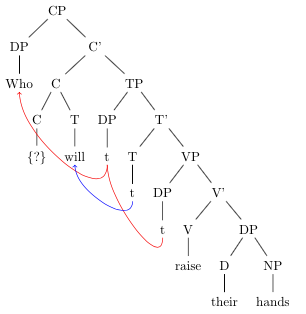
- In generative syntax, you often see trees like this:
Movement
- Examine this code in LaTeX. How do you show movement?
\documentclass{standalone}  % class to make a single image
\usepackage{newtx}  % Times font clone
\usepackage[linguistics]{forest}
\forestset{default preamble={for tree={edge=semithick}}} % thicker edges

\begin{document}
\begin{forest}
[TP [DP\\John, name=SpecTP]
    [T$'$ [T\\\textsc{past}]
        [vP [DP\\t, name=SpecvP]
            [v$'$ [v [V\\roll, name=littlev] [v]]
                [VP [DP [D\\the] [NP\\ball]]
                    [V$'$ [V\\t, name=bigV]
                        [PP [P\\down]
                            [DP [D\\the] [NP\\hill]]]]]]]]]
\draw[->] (SpecvP) to[out=south west, in=south] (SpecTP);
\draw[->] (bigV) to[out=south, in=south] (littlev);
\end{forest}
\end{document}
Movement Activity
- Using the code on the previous slide as a model, draw a tree for “What did you do?”
- Assume that “what” begins as the direct object (comp of V\('\)), and moves to spec of CP
- Assume that “did” is base generated in T and moves to C
For More on Movement & Syntax Trees
see https://www.kennethhanson.net/teaching/latex-tree-drawing/
Answers to Activities
gb4e Activity
\documentclass{article}
\usepackage{gb4e}
\begin{document}

\begin{exe}
\ex
\gll Ali kitab-ı oku-du.\\
Ali.NOM book-ACC read-PST.3SG\\
\trans `Ali read the book.'
\end{exe}

\begin{exe}
\ex[*]{
\gll Weil er hat das Buch gelesen.\\
because he has the book read.PTCP\\
\trans `Because he has read the book.'}
\end{exe}

\begin{exe}
\ex
\gll Maria wasi-ta riku-sha-n.\\
Maria house-ACC see-PROG-3\\
\trans `Maria is looking at the house.'
\end{exe}

\end{document}
Syntax Tree activity
\documentclass[12pt]{article}
\usepackage[T1]{fontenc}
\usepackage[utf8]{inputenc}
\usepackage{forest}     % trees

% A clean, reusable style for our trees:
\forestset{
  mytree/.style={
    for tree={
      align=center,
      parent anchor=south,
      child anchor=north,
      edge={-Latex},     % arrowed edges; swap to draw,-> etc.
      s sep=8mm,         % sibling sep
      l sep=8mm,         % level sep
      inner sep=2pt,
      rounded corners
    }
  }
}

\begin{document}
% Requires: \usepackage{forest}
\begin{forest}
  for tree={
    align=center,
    parent anchor=south,
    child anchor=north,
    edge={-Latex},
    s sep=8mm,
    l sep=8mm,
    inner sep=2pt,
  }
  [TP
    [DP
      [D [That] ]
      [NP [cow] ]
    ]
    [T$'$
      [T [can] ]
      [VP
        [V$'$
          [V [jump] ]
          [PP
            [P [over] ]
            [DP
              [D [the] ]
              [NP [moon] ]
            ]
          ]
        ]
      ]
    ]
  ]
\end{forest}
\end{document}
Movement Activity
\documentclass{standalone}  % single-image output
\usepackage{newtx}          % Times-like font
\usepackage[linguistics]{forest}
\forestset{default preamble={for tree={edge=semithick,align=center}}}
\usetikzlibrary{arrows.meta}

\begin{document}
\begin{forest}
[CP
  [DP\\\emph{what}$_i$, name=SpecCP]             % landing site (Spec-CP)
  [C$'$
    [C\\did, name=Chead]                         % did in C after T→C
    [TP
      [DP\\you, name=SpecTP]
      [T$'$
        [T\\t, name=Thead]                       % trace of did in T
        [VP
          [V$'$
            [V\\do, name=Vhead]
            [DP\\t$_i$, name=ObjTrace]          % original object position
          ]
        ]
      ]
    ]
  ]
]
% ---- movement arrows ----
\draw[dashed,->] (ObjTrace) to[out=south west, in=south] (SpecCP); % DP (obj) → Spec-CP
\draw[dashed,->] (Thead)    to[out=south, in=south]       (Chead);  % T → C (did)
\end{forest}
\end{document}
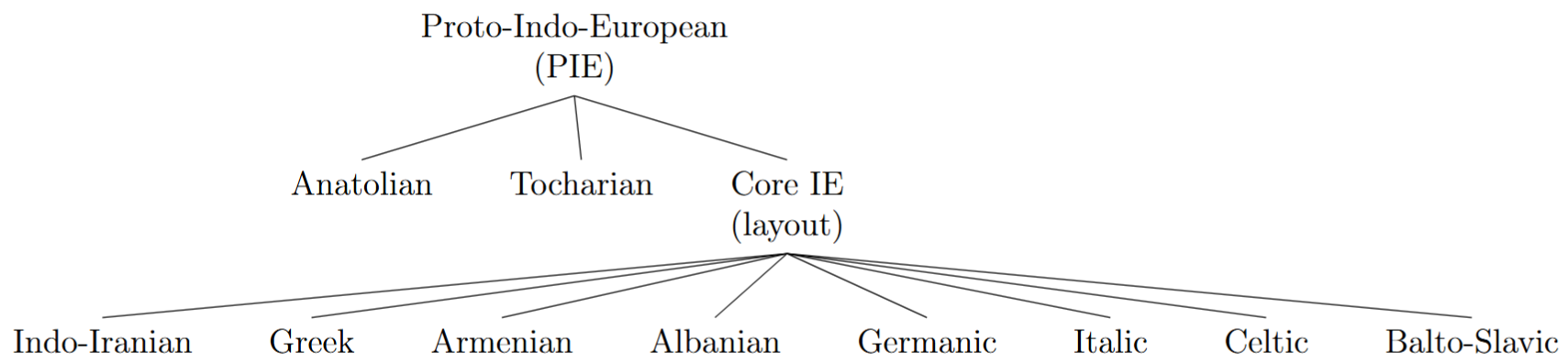
Indo-European Stammbaum Code
\documentclass[12pt]{article}
\usepackage[T1]{fontenc}
\usepackage[utf8]{inputenc}
\usepackage{graphicx}
\usepackage{forest} % -> TikZ-based tree drawing

% A clean, readable forest style
\forestset{
  ie tree/.style={
    for tree={
      align=center,
      parent anchor=south,
      child anchor=north,
      edge={-Latex},
      s sep=8mm,      % sibling separation
      l sep=8mm,      % level separation
      inner sep=2pt,
    }
  }
}

\begin{document}
\thispagestyle{empty}

% ---- Indo‑European Stammbaum with a "Core IE (layout)" node ----
\begin{center}
\scalebox{0.8}{ % shrink to 80%
\begin{forest}
  ie tree
  [Proto-Indo-European\\(PIE)
    [Anatolian]
    [Tocharian]
    [Core IE\\(layout)
      [Indo-Iranian]
      [Greek]
      [Armenian]
      [Albanian]
      [Germanic]
      [Italic]
      [Celtic]
      [Balto-Slavic]
    ]
  ]
\end{forest}}
\end{center}

% (Presentation note: “Core IE (layout)” is just a layout convenience,
% not a phylogenetic claim.)

\end{document}